Certified Roof Anchors: What Property Managers Should Ask Before High-Rise Window Cleaning
The anchor points on your roof carry the entire weight of the job, so it pays to know who has checked them.
October 20, 2026 · 4 min read
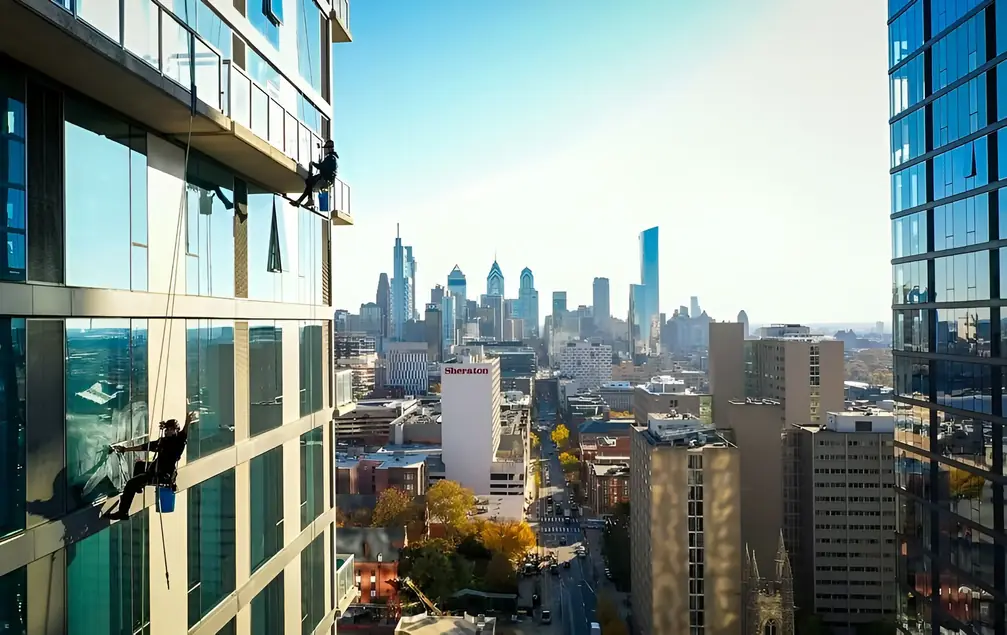
When a crew rappels down the face of a tall building to clean the glass, everything depends on a few pieces of hardware most people never see. They are on the roof, and they are called anchors. If you manage a high-rise, those anchors are part of your building, and it is reasonable to ask whether they have been properly checked before anyone ties in to them.
What a roof anchor does
A building anchor is a fixed attachment point, installed on the roof or the structure, that a technician's rope system connects to. It is the end of the line, literally. The rope, harness, descent device and backup line all lead back to it. If the anchor fails, nothing else in the system matters, which is why the industry treats anchors as safety equipment and not as a roof accessory.
Anchors live outdoors for years. They sit through freezing winters and hot summers, rain, ice and the occasional roofing project that happens around them. Metal corrodes, fasteners loosen, and what was installed correctly a decade ago may not be the same today. That is the reason inspection and testing schedules exist.
The schedule Premier works to
Premier Window Cleaning is blunt about this. Its position is that it will never perform work without properly inspected and certified building anchors. Anchors must be visually inspected every year and load tested every 10 years. The load test is repeated sooner if the roof or the structure around the anchor has changed.
A visual inspection is what it sounds like: a trained person looks over each anchor and its connection to the structure for signs of damage, wear or corrosion. A load test is more demanding. The anchor is loaded to confirm it holds, which tells you something a visual check cannot. One finds problems early, and the other proves the anchor will do its job.
Why the sister company matters
Premier has a sister company, Premier Building Anchors, that handles anchor inspection, testing and certification. For a property manager, that means the window cleaning contractor and the anchor specialist can coordinate. If an anchor needs attention before a job, there is one group of people who understand both the cleaning schedule and the hardware, and the same organization can take care of the anchors and the windows together.
Questions worth asking any contractor
You do not need an engineering background to ask good questions. These cover most of what a property manager needs to know.
- When were the anchors on my building last inspected, and who inspected them?
- When was the last load test, and is the certification documentation available for me to see?
- Has anything changed on the roof since then, such as new membrane, equipment or structural work?
- Will your crew refuse to start work if an anchor is not current?
- Are your technicians trained and certified for rope access, and how often are they recertified?
A contractor who is comfortable with this will answer plainly. If you get vague answers or a request to take their word for it, treat that as information.
The people on the rope
Anchors are one half of the system. The other half is the person using them. Premier's technicians are IWCA-certified rope access professionals, with initial training and annual recertification in fall protection, rope handling and rigging, aerial lift operation, first aid and emergency response. Equipment such as harnesses, ropes, lifelines and descent control devices is inspected and documented, and on-site rescue equipment and trained rescue leads are part of the plan. The company states compliance with OSHA, ANSI I-14 and IWCA practices on every project, whatever its size.
It also helps that the crews are in-house. Premier's 35 union professionals are its own employees and the work is never subcontracted, so the person asking about your anchors works for the same company as the person using them.
Why this belongs on a property manager's radar
Roof anchors can feel like someone else's problem until you think about who holds the risk. They are installed on your structure, and the work happens on your building, with your tenants, visitors and neighbors on the ground. Knowing the inspection dates, keeping the certification paperwork on file, and telling your contractor about roof work before it happens are small habits that protect a lot of people.
A simple practice is to keep an anchor record next to your other building maintenance logs: date of the last annual inspection, date of the last load test, and a note any time roofing or structural work happens nearby. When a window cleaning bid comes in, ask for the contractor's answers to the questions above in writing.
If you are not sure where your building stands, Premier will walk you through it. Call (267) 534-5198 and ask about anchor inspection and certification through Premier Building Anchors, along with a free estimate for the window work.
Premier Window Cleaning, LLC, (267) 534-5198
Call (267) 534-5198More articles
How Often Should a Philadelphia Commercial Building Have Its Windows Cleaned?
There is no single number that fits every building, but there is a sensible way to land on yours.
Getting Your Home Ready for a Window Cleaning Visit
A few minutes of preparation means the crew spends its time on your glass instead of your knickknacks.